
Shamcher: Mystic Engineer
Welcome to a new issue of The Shamcher Bulletin. Special greetings to new subscribers!
At the end of April, the Bulletin always celebrates Shamcher Week, with Shamcher’s birthday (April 26, 1896) and his passing (April 29, 1980). Let’s take a moment to reflect on his wide-ranging presence and influence.
In this issue: First is my illustrated overview remembrance, followed by a reflection for today. We end by sharing the commemorative issue of SCC Chronicles, Remembering Shamcher Beorse,
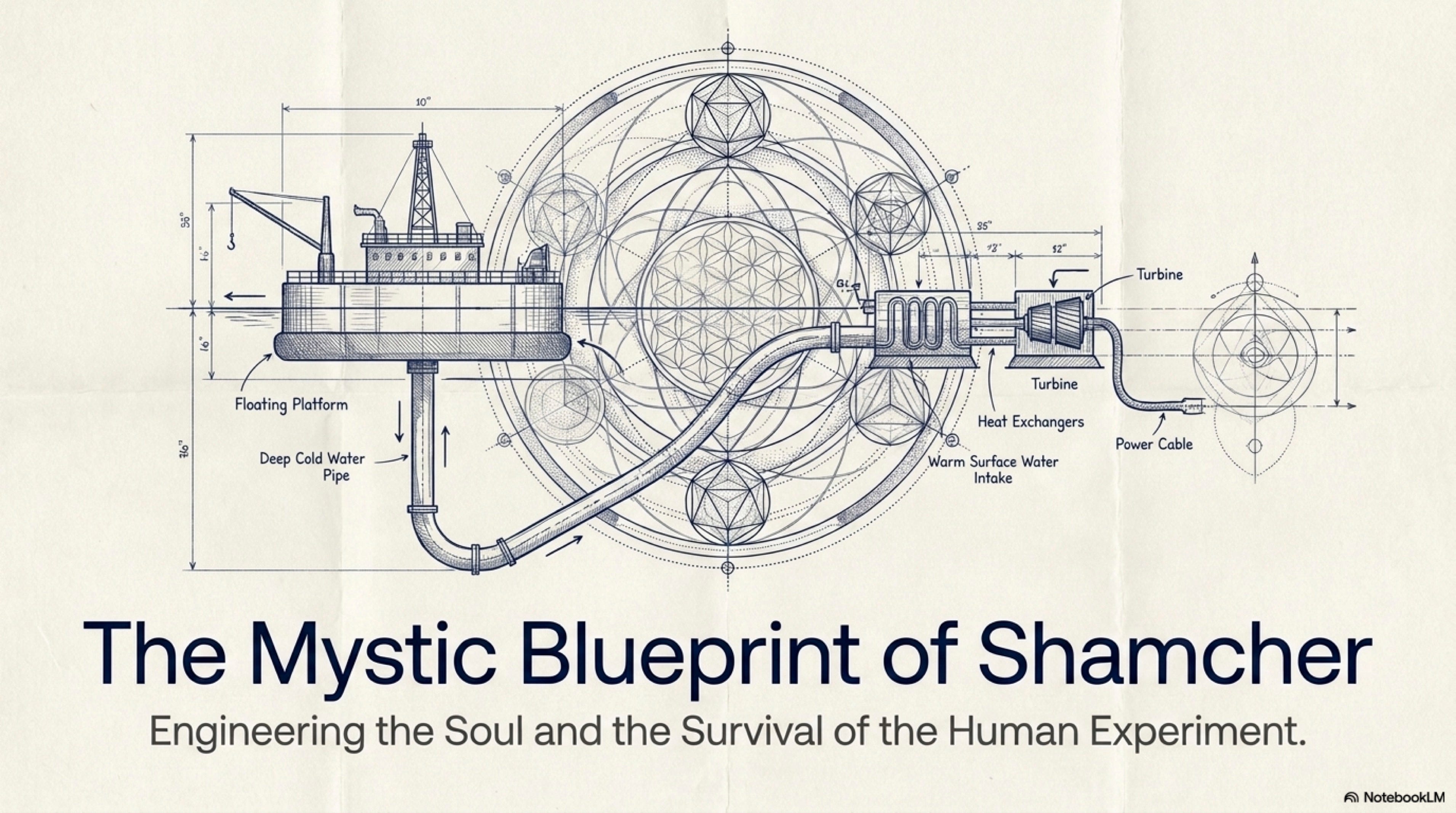
Mystic, Author, Engineer
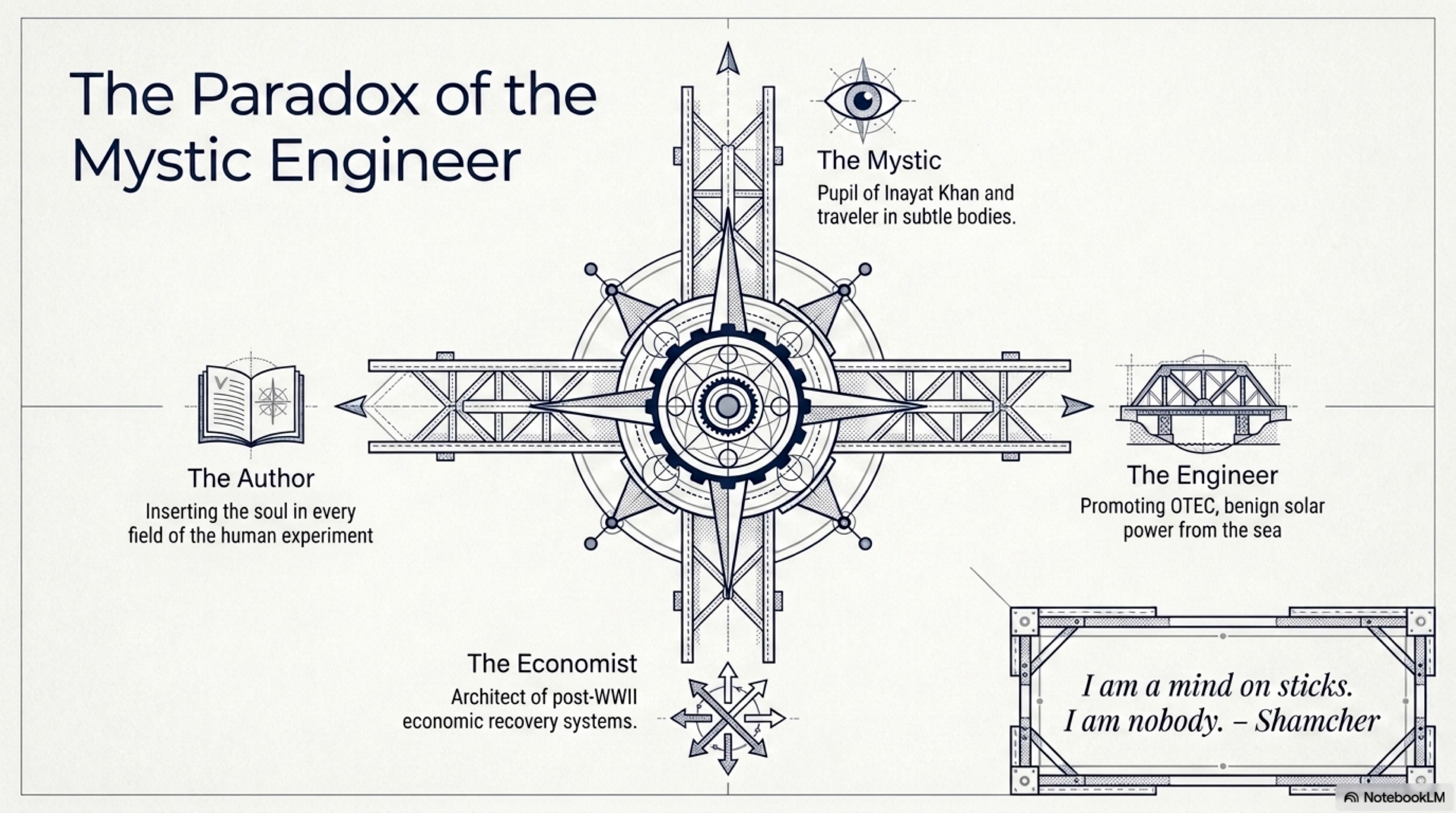
My first connection with Shamcher was because he was a mystic, and I soon found he was a yogic Sufi who was able to open space for the soul to engage in the greater spheres of being. I was drawn to find him under the wing of the great Sufi Inayat Khan, whose words awakened in me the necessity of further expansion. Personal circumstances made this connection a powerful imperative, but when I met Shamcher I had no idea he had been a pupil of Inayat Khan, whose books I’d read so avidly.
In the connection to the divine mind, for decades (lifetimes?) Shamcher had been following the inner instructions from his Himalayan contacts as well as the being of Inayat Khan. In a way, he was always Inayat Khan’s translator, from that first time of meeting him to translate the lecture in Norway. Here the lasting contact was first made. And Shamcher said that from that time he was able to share mind with Inayat but no others until very late in his life.
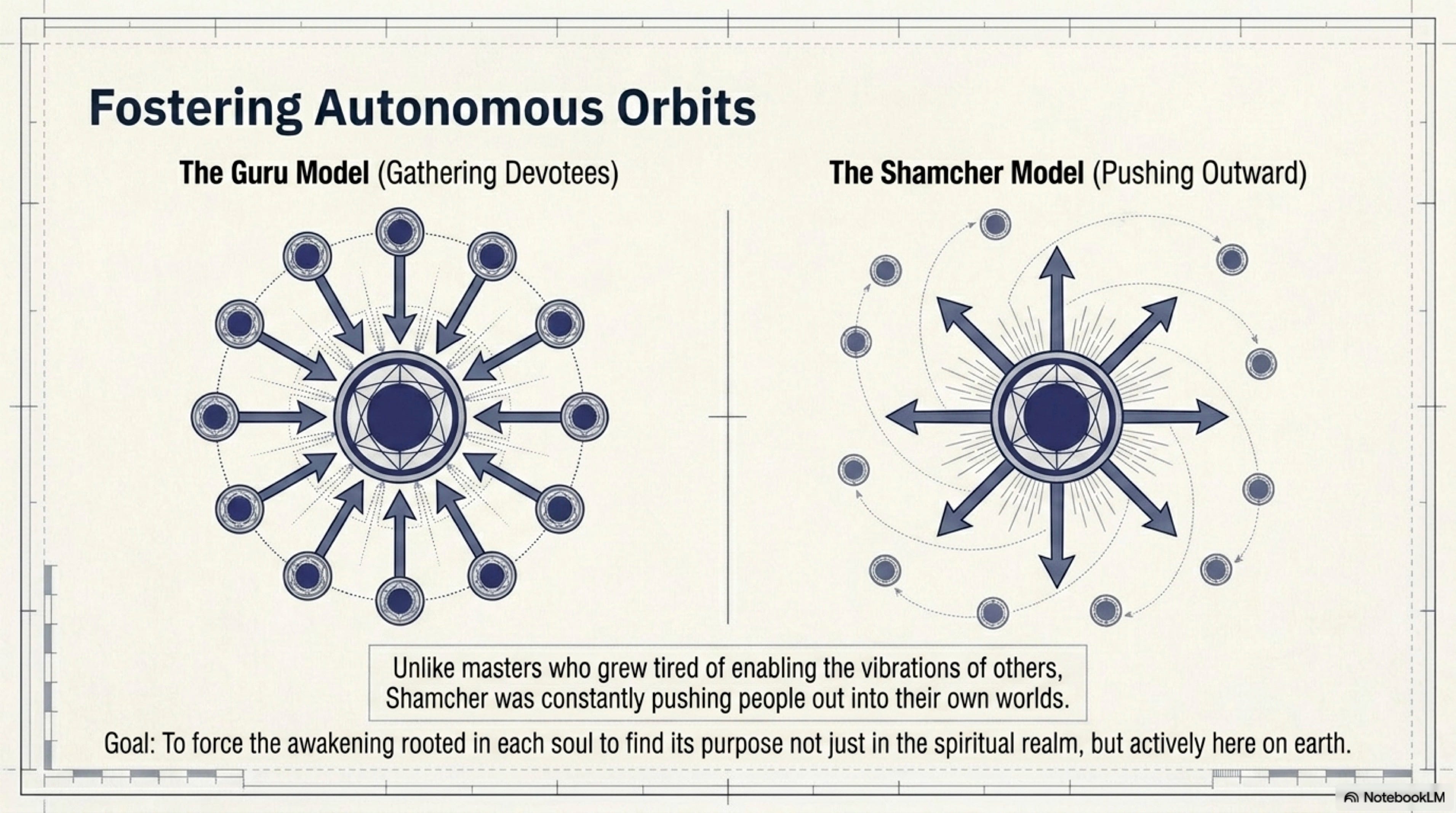
Perhaps it expanded even more after he had his near death experience in a road accident, where he saw and talked with his parents and met with Inayat Khan, who explained to him so much, and told him about how he had to leave after he became tired of enabling the vibrations of others.
Well, Shamcher was never in that boat, he was always pushing people out, into their own world, where the awakening rooted in the soul of each was to find its way, not only in the spiritual world but to find the soul’s purpose here on earth.
Shamcher himself lived his purpose to its utmost within the constraints of the times in which he operated. His intuition was fully activated and by following those instructions he entered all the fields of endeavour that were significant and influential at the time. He was first an engineer, a designer of the bridge-building, earth moving, dam-making and all that early 20th century infrastructure for the benefit of humanity. It led him around the world, and then to OTEC. It brought him to see how these ideals, and lofty inventions from the souls of so many inspired scientists were blocked or held back by the influences of economics and geopolitics. Asked if he was angry at the opposition, he replied, “They give me the opportunity to work.”
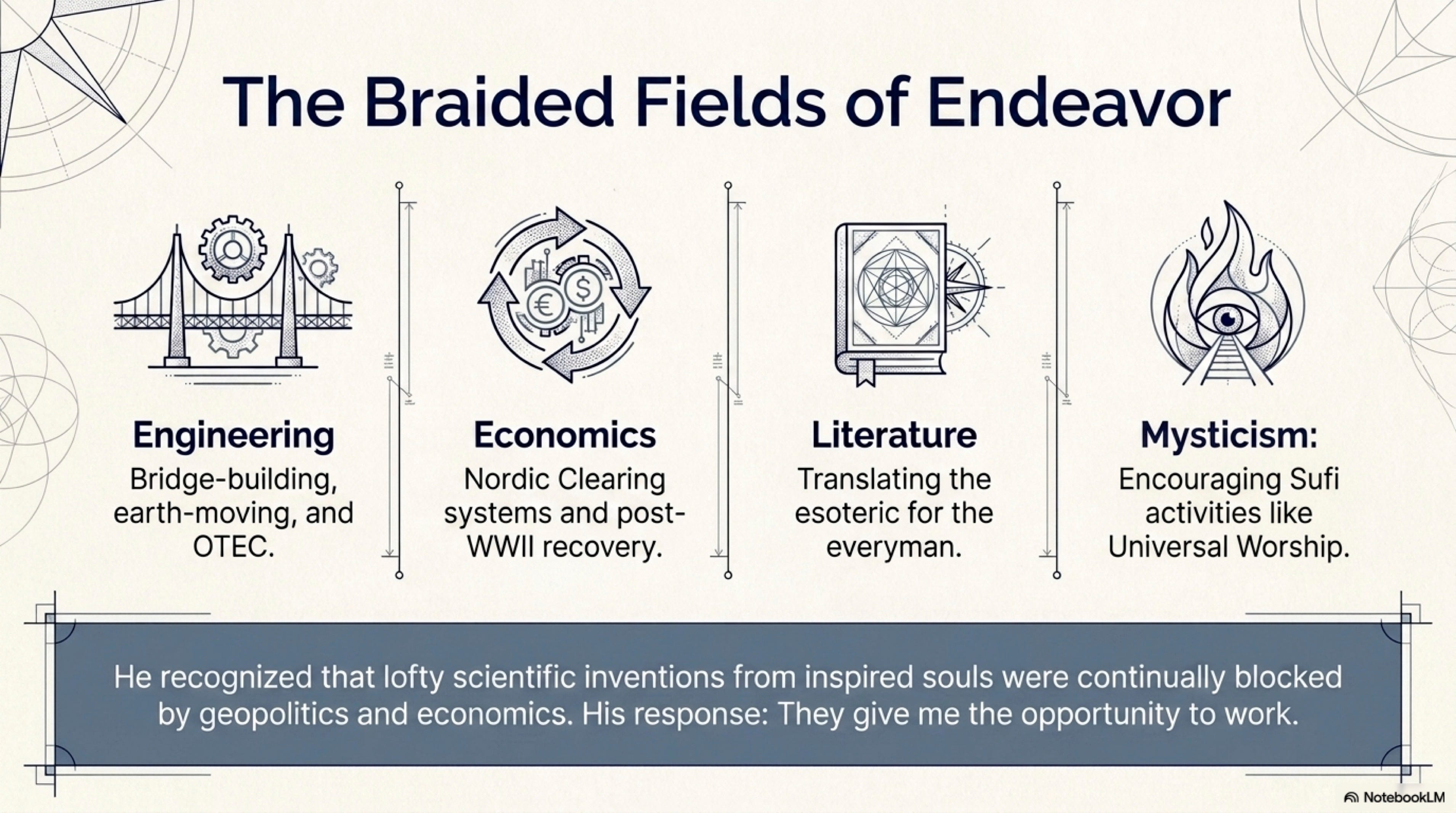
While he was still young he entered the economic field too, as an ad hoc economist, writing an overview of different economic theories of the day, looking for new ways of approach in economy and employment. He achieved some notice in that field and connection to other prominent economists. As well as helping to found and encourage the pre-war GiroCredit system called Nordic Clearing, he was nominated to help Norway’s economy recover from the devastation of WWII.
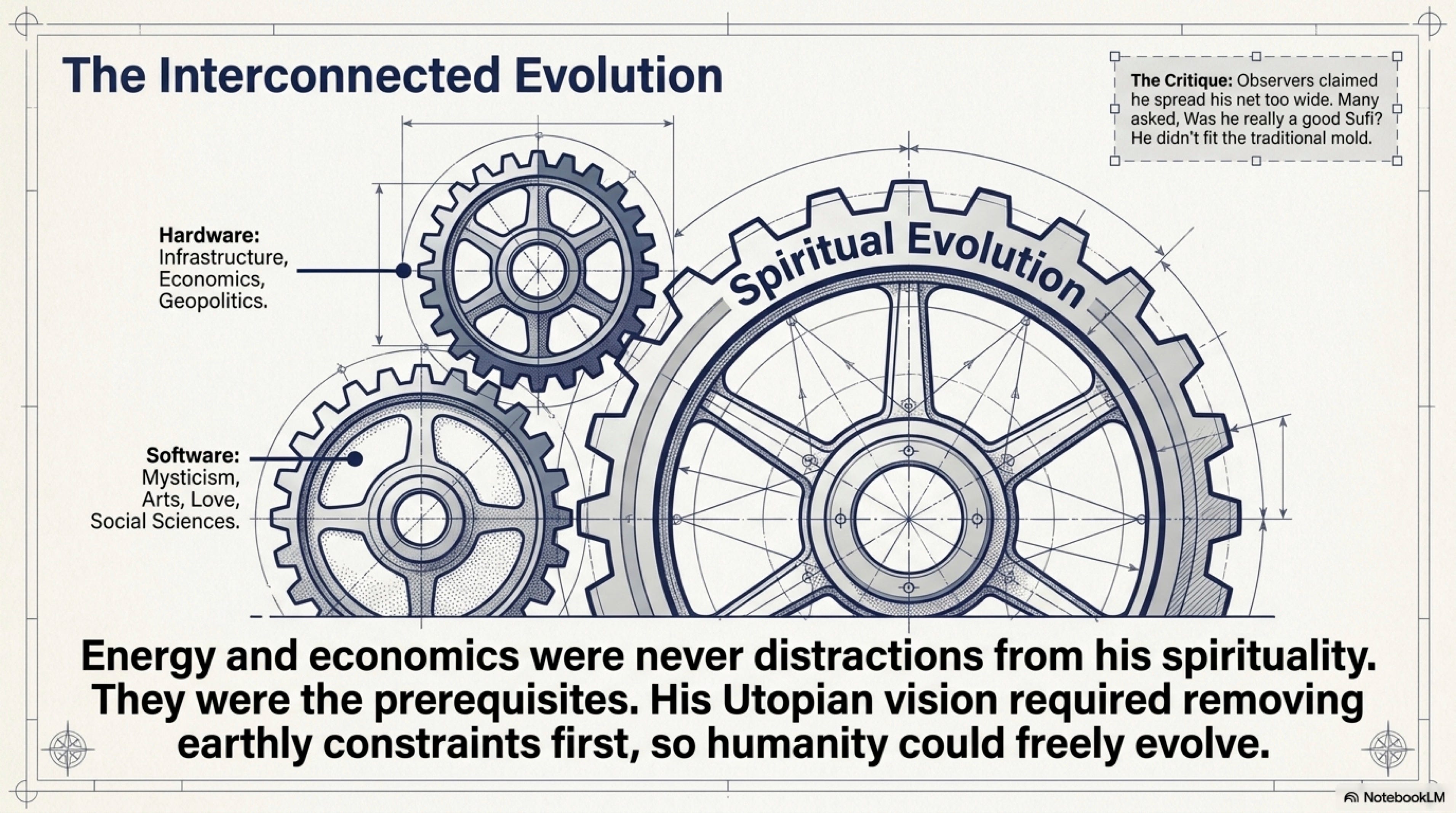
The braided fields of energy, economics and employment activated in him a vision of a new world and evolution for humanity, and in that vision, all other aspects such as education, mysticism, love, social sciences and the arts were fostered in harmony with one another. This utopian vision was possible, he posited, once humanity would be in a position to evolve without the constraints from the forces that had been in the way for so long.
For this purpose he became an author, and wrote books for the “everyman” on these topics, bringing all into play at once, as a generalist, but always with the interconnection of these forces in mind. Sometimes geopolitics took the foreground, as with A State of Almost Happiness on China, or A Sufi Went to War, his book on his wartime experiences. Also the unpublished book on the Norwegian Underground, based on his experiences and those of others. And don’t forget, he was a driver for the plot to kidnap Hitler, which he proposed to Roosevelt who rejected it, saying, “I want the Germans to be beaten so they know it.”
“What? Why didn’t he write Sufi books?” you might ask. Well, he tucks in this teaching in all the books, but Fairy Tales are True is probably the most Sufi since it does go into the Khumba Mela and the meeting with a great sage. Here it is the great sage who in his simple presence unites the seemingly varied disciplines, embodied by characters who represent diverse areas of knowledge, led by a Shamcher-like nobody figure to meet the sage who unifies their quest. (Along with a side-trip to life in the California Dunes.)
It was in wartime that he first felt the message from Inayat to write a book not an economics, but something else. So he put together episodically his own impression of the popular This Mysterious Universe by James Jeans (who was one of the models later for a character in Fairy Tales are True) and wrote Man and this Mysterious Universe. By including humanity in the physics of all being, Shamcher inserted a variable that physicists can decode, using all their esoteric data based not only on averages but on the working of a single particle to transform the whole.
He brought so much to the 20th century situation that there are few words to express it, or too many? Being a generalist, he didn’t ever achieve any one goal, but spread his net wide - some who didn’t understand said too wide. Was he really a good Sufi? Not to many. He was too much his own man.
And yet, at a gathering, Pir Vilayat named him the Esoteric Head of the Sufi Order, something that Shamcher didn’t deny. For at just before Vilayat spoke, Shamcher had fallen into a contemplative reverie that told him the same thing, without words.
He operated in the subtle bodies at all times. So when he founded the Sufi group in Edmonton, his full net was expanded and a node of it landed on this little place nowhere in northern Canada. This place was where the Social Credit system had been operating (and he had studied social credit, as part of his girocredit plan and economic surveys.) He found us few who became his vehicles to express something that the Sufis needed to also have in their being. For he had not been an adherent of any one religion, and was keen not to put all that beautiful opening into any one box. He gave us all permission to be, to become, to explore, to expand, to seek and perhaps to find.
Shamcher was a strong advocate for Universal Worship, and performed it wherever he could, in all the countries he visited. I recall him in the airport seeing signs in French and English, and saying how beautiful Inayat Khan’s prayers are in French, where he began to very quietly recite the first prayer, Saum, like singing a song. Like the singer in A State of Almost Happiness.
Something small can hold the monumental in its core, just as a symbol is an ocean in a drop. Shamcher’s range and actions may have appeared small. At heart they were an active manifestation of our connected evolution - the human endeavour. He desperately wanted the human experiment to survive. “I am a mind on sticks,” he would say. “I am nobody,” he would say.
So why do we remember him, and how do we remember him?
I remember how I felt when I was with him, in the vastness of being. It wasn’t always vast, often mundane or particular, but the capacity for the vastness was immanent and made all around him also in that field. And when I asked him how I could feel the same way I do when he wasn’t there he said, “Well you could do the zikar,” and then demonstrated a couple of zikars, with different melodies for different purposes. Later he was to emphasize the English zikar practice- this is not my body, this is the temple of God, this is not my mind, it is the mind of God, this is not my heart it is the altar of God.
“I am shouting myself hoarse,” he would say of his efforts to make the powers that be understand their dangerous directions. He was and is a strong influence in the current world, and more than ever now Sufis, yogis and spiritually-minded people are seeing the reality in which our divine souls have become enmeshed. He advocated that we each take the action that the integrity of our soul perceives, working to the best of our ability, but not to the detriment of others.
Someone asked Shamcher, “What do you think of the New Age?” and he replied, “It may be new to you!”
He was active and engaged in the coexistent reality base of flexible power waves - sometimes wave and sometimes particle, but never for long, always in the flow. Only a cultivated intuition can engage to perhaps manage and direct this flow.
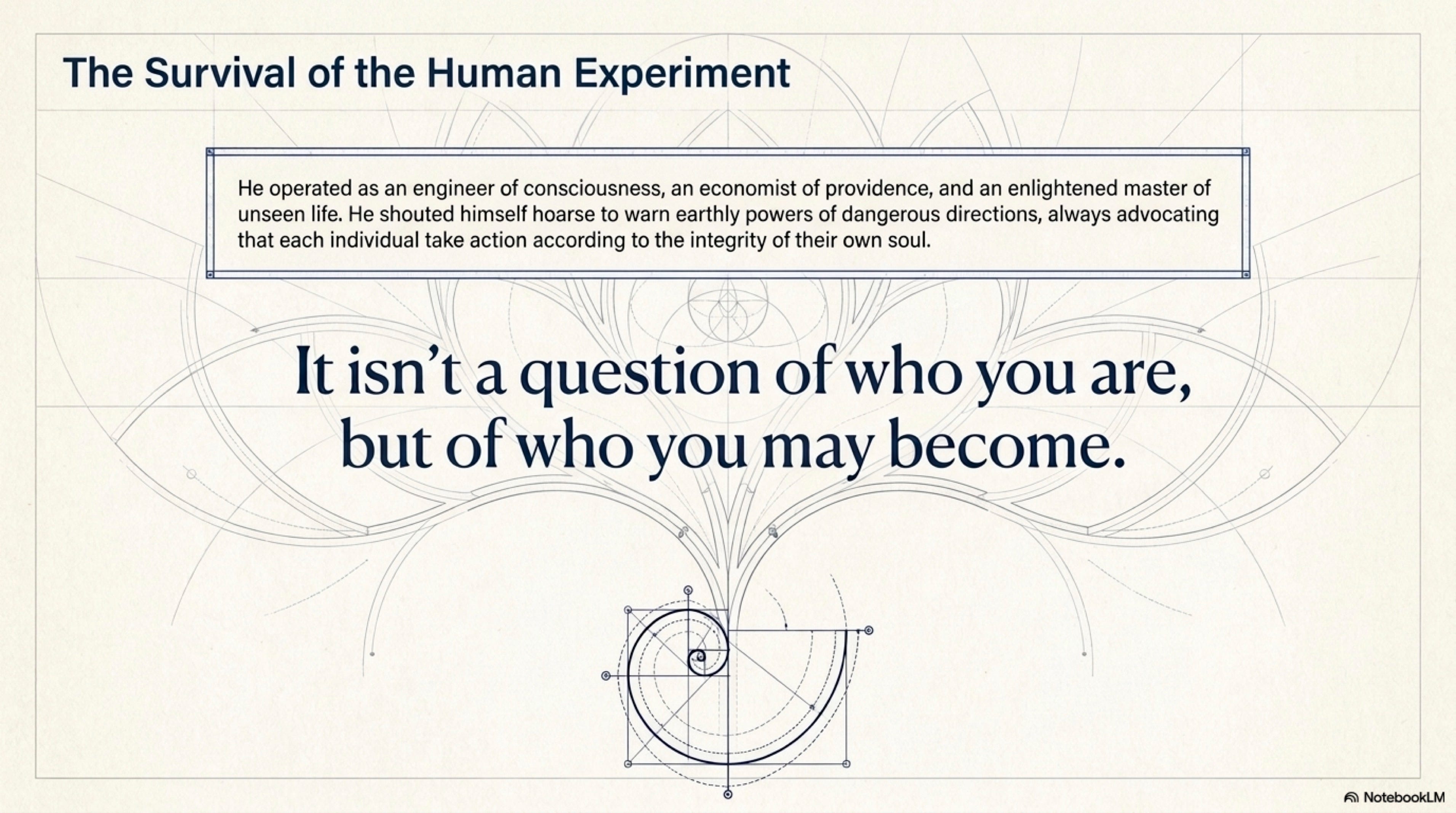
Shamcher was like an engineer of consciousness, like an economist of the give and take of providence, like an enlightened master of the powers and beauties of the unseen life. He saw it all, and to his best, he embodied what he could. Not directly in his physicality in this dimension, which was only a pinpoint for the “mind on sticks” but in all the nodes in his expanding luminous net of being. And each of these nodes he activated as needed, like a true Brahmin. He travelled electrically in this vast subtle body which the divine universe then enabled to act as it landed in various fields of endeavour, individuals he was in touch with, locations on earth, or simple ideas planted like seeds to be fostered over the vastness of time.
I’m reminded of a quote, and I wonder who said it. Perhaps Yogananda? “It isn’t a question of who you are, but of who you may become.”
Today
Many people are asking what Shamcher would be thinking about our global situation these days, and from time to time he may give a response if we ask within. But it may not be what we think or hope he might say to affirm our particular bias. All I know is that it is up to us to find our own intuition and understanding of the rapidly shifting changes and event points that drive our current geopolitics.
Don’t rob God of his options, he would say.
He often said that God’s mind changes, and Shamcher exemplified that himself, also changing his mind as circumstances and new information came to him. A good example of that is his relationship to nuclear power, which at first he wholeheartedly endorsed, even basing his book The Future is Ours on this premise of free electric power for the world. Then, later on, as he adapted and changed, Shamcher supported anti-nuclear approaches as he advocated for OTEC and solar power alternatives.
Now, how would he react?
What does it matter what Shamcher would say? We should ask the ancient question, “What is up to us?” For Shamcher is no longer here bound on earth with all the ebb and flow, shift and re-shift of circumstances and conditions. It is here in our earthly life that we imagine God is defining all this. In the current of events, we humans have an influence - both physically and metaphysically. We do have a say in the play.
Shamcher quoted his teacher Inayat Khan often, and in conversation it seemed he was translating the Message into the moment for today. This was his ability and attainment. Shamcher could absorb the conditions, and relay the message for their evolution and development, as an agent for good. But only for that moment, and only for that particular circumstance. Not as a blanket statement of fact forevermore. That is why he agreed with Inayat that a book is a dead teacher, for when words are frozen in time on the page they cannot be corrected to adapt to the new circumstances. And life is all about new circumstances. The manifestation of creation.
Shamcher asked us all to get into our lives as they are and give them all we have. This is the devotion and the challenge. In this way he was as much engaged as Arjuna on the chariot with Krishna in the Bhagavad Gita. He didn’t hold back but went forward into the battle of life. He dared, in wartime, to join the Norwegian Underground, and he dared to work with British Intelligence. He dared to face Nazi interrogation, and he dared to plan to kidnap Hitler. He was a hunter of truth, and a gatherer of beauty, and a meditator in action. So his life went forward from one unfoldment to the next.
And if we wonder what to do?
His story of first meeting Inayat Khan in the hotel in Oslo before translating his lecture is a good example. “Gentlemen, let us have silence.” Shamcher and an interloper, sitting on either side of Inayat Khan, in silence together, then dismissed. He still didn’t have his answer to how the translation would happen - sentence by sentence or…? but somehow, without forethought, after Inayat had spoken to the audience in English, Shamcher stood and gave Inayat’s lecture in full, in his native Norwegian.
And again, he thought he wouldn’t be joining with Inayat, since he was already part of another organization, yet he changed his mind and asked for initiation, which Inayat gave to him, in a train car.
What changed his mind was not more information, but less. Not more ideas but fewer. With that came a beam of communication, something we could call a message. An instruction. For action.
More for you to read today
Tuck in to the Shamcher-featured issue of Sufi Circle Canada Chronicles: an article and new song by Nirtan Sokoloff, news clippings and a quote sourced by David Murray, gathered together by Carol Sill. Link through the image to read.

Images in this issue were made with NotebookLM
Thanks for subscribing! Feel free to reply to this post if you have any Shamcher stories, photos or correspondence to share.
The Shamcher Bulletin is edited by Carol Sill, whose newsletter, “Personal Papers”, is HERE.
If you like this post, please click the heart. And your comments are always welcome.
Thank you Carol again for your work and stories and insights of, from and with Shamcher. I love the position of empowering people to be and do what THEY can. I really feel this is the message for our time, and can step back and say each will InshAmma know their own way, and each will find the kind of guide or teacher that they need. Thank you so much for your dedication to passing on the insights and wisdom that you experienced and have grown through your letters and being with him. Love and Gratitude, ZubinNur ~\/~
As an Edmontonian, who met Shamcher briefly at Carol and Gary Sill's home in the 1970s, I have come to realize how much he directed my future, especially his inspiration to start a sufi retreat in the Rocky Mountains at Lake O'Hara. And I am still learning about his mystical life. Thanks Carol.